

Income Tax Planning & Filing Tips (FY 2026-27): A Complete Guide for Salaried Individuals and Business Owners
Income Tax Planning & Filing Tips: Save More Tax the Right Way
Income tax planning is not just about saving tax at the end of the financial year. It is about making smart financial decisions throughout the year while ensuring compliance with the Income Tax Act.
Whether you are a salaried employee, business owner, freelancer, professional, or retiree, proper tax planning can help you reduce your tax liability legally, avoid penalties, and maximize your savings.
This guide explains practical income tax planning strategies and important filing tips to help you file your Income Tax Return (ITR) accurately and on time.
Why Income Tax Planning is Important
Effective tax planning helps you:
- Reduce your tax liability legally.
- Avoid interest and penalties.
- Improve cash flow management.
- Make informed investment decisions.
- Ensure timely tax compliance.
- Claim all eligible deductions and exemptions.
- Build long-term financial security.
Planning your taxes throughout the year is always better than rushing to invest just before the filing deadline.
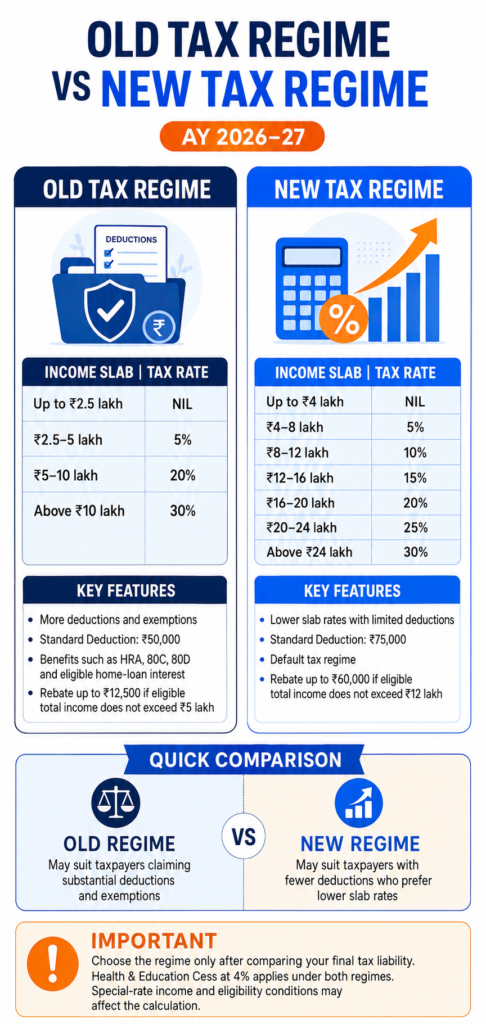
Understand Your Tax Regime
Taxpayers can generally choose between the available tax regimes, subject to the applicable provisions of the Income Tax Act.
Before filing your return, compare both options carefully based on your income, eligible deductions, exemptions, and financial goals. Choosing the right regime can significantly impact your tax liability.
Professional guidance can help you determine which option is more beneficial for your specific situation.
Start Tax Planning Early
One of the biggest mistakes taxpayers make is waiting until the last few weeks of the financial year.
Instead:
- Estimate your annual income.
- Calculate your expected tax liability.
- Plan eligible investments.
- Track deductions regularly.
- Maintain proper records.
Early planning gives you more flexibility and avoids last-minute financial pressure.
Maintain Proper Financial Records
Good record keeping makes tax filing simple and reduces the chances of errors.
Keep copies of:
- Salary slips
- Form 16
- Bank statements
- Interest certificates
- Investment proofs
- Rent receipts (where applicable)
- Home loan statements
- Insurance premium receipts
- Medical insurance documents
- Capital gain statements
- Business expense records
- GST records (for businesses)
Store these documents digitally as well as physically for future reference.
Report All Sources of Income
Many taxpayers mistakenly report only their salary income.
Remember to disclose all applicable sources of income, including:
- Salary
- Business or professional income
- Interest from savings and fixed deposits
- Rental income
- Capital gains
- Dividend income
- Freelancing income
- Commission or consultancy income
- Foreign income (where applicable)
- Other taxable receipts
Reporting complete and accurate information helps avoid notices and future disputes.
Verify Your Form 26AS, AIS and TIS
Before filing your Income Tax Return, always reconcile your income details with:
- Form 26AS
- Annual Information Statement (AIS)
- Taxpayer Information Summary (TIS)
This helps identify:
- Missing TDS credits
- Additional income reported by financial institutions
- High-value transactions
- Incorrect tax credits
Any mismatch should be resolved before filing your return.
Claim Eligible Deductions
Many taxpayers fail to claim deductions they are legally entitled to.
Depending on your eligibility and the applicable tax regime, you may be able to claim deductions for:
- Life insurance premiums
- Employee Provident Fund (EPF)
- Public Provident Fund (PPF)
- National Pension System (NPS)
- Health insurance premiums
- Home loan interest
- Education loan interest
- Donations to eligible institutions
- Certain disability and medical expense provisions
Always maintain supporting documents for every deduction claimed.
Which ITR Form Should You File?
Choosing the correct Income Tax Return (ITR) form is essential for accurate filing. The form depends on your source of income, residential status, and total income.
ITR-1 (Sahaj)
Resident individuals with income up to ₹50 lakh from Salary/Pension, One House Property (excluding certain cases), and Other Sources (such as interest).
ITR-2
Individuals and HUFs not having business or professional income. Suitable for those having Capital Gains, Multiple House Properties, Foreign Assets/Income, or income above the eligibility of ITR-1.
ITR-3
Individuals and HUFs having income from Business or Profession, including proprietors, consultants, freelancers, and partners receiving remuneration or interest from a partnership firm.
ITR-4 (Sugam)
Resident Individuals, HUFs, and Firms (other than LLPs) opting for the Presumptive Taxation Scheme under sections 44AD, 44ADA, or 44AE, subject to prescribed conditions.
ITR-5
LLPs, Partnership Firms, AOPs, BOIs, Artificial Juridical Persons, and other entities (except companies and those required to file ITR-7).
ITR-6
Companies other than those claiming exemption under Section 11 (charitable or religious trusts).
ITR-7
Trusts, Charitable Institutions, Political Parties, Educational Institutions, Religious Organizations, and other entities required to file returns under specified sections of the Income Tax Act.

How SLH Advisors Can Help
At SLH Advisors, we provide complete Income Tax solutions for individuals, professionals, firms, companies, and startups.
Our services include:
- Income Tax Return Filing
- Tax Planning
- Tax Saving Consultation
- Business Income Tax Compliance
- Capital Gain Computation
- Advance Tax Planning
- Tax Audit Assistance
- Income Tax Notice Response
- TDS Compliance
- Financial and Tax Advisory
Our experienced professionals ensure timely, accurate, and hassle-free tax compliance tailored to your financial needs.