
GST Compliance and GST Returns: A Complete Guide for Businesses in 2026
GST compliance is not limited to filing one return every month. It includes issuing correct tax invoices, maintaining proper records, reconciling Input Tax Credit, paying tax within the due date, filing applicable returns, generating e-invoices and e-way bills, and responding to GST notices.
Even a small mismatch between sales records, GSTR-1, GSTR-3B, GSTR-2B and accounting books can lead to interest, late fees, blocked Input Tax Credit or departmental notices. Therefore, businesses should treat GST compliance as a regular monthly process.
What Is a GST Return?
A GST return is a statement filed by a registered taxpayer on the GST portal. Depending on the type of return, it may contain:
- Details of sales and outward supplies
- Purchase and inward-supply details
- Output GST liability
- Eligible Input Tax Credit
- Reverse Charge Mechanism liability
- Exempt, nil-rated and non-GST supplies
- Tax, interest and late-fee payments
- HSN or SAC-wise summary
- Details of credit notes, debit notes and amendments
The type and frequency of return depend on the taxpayer’s registration category, turnover and nature of business.
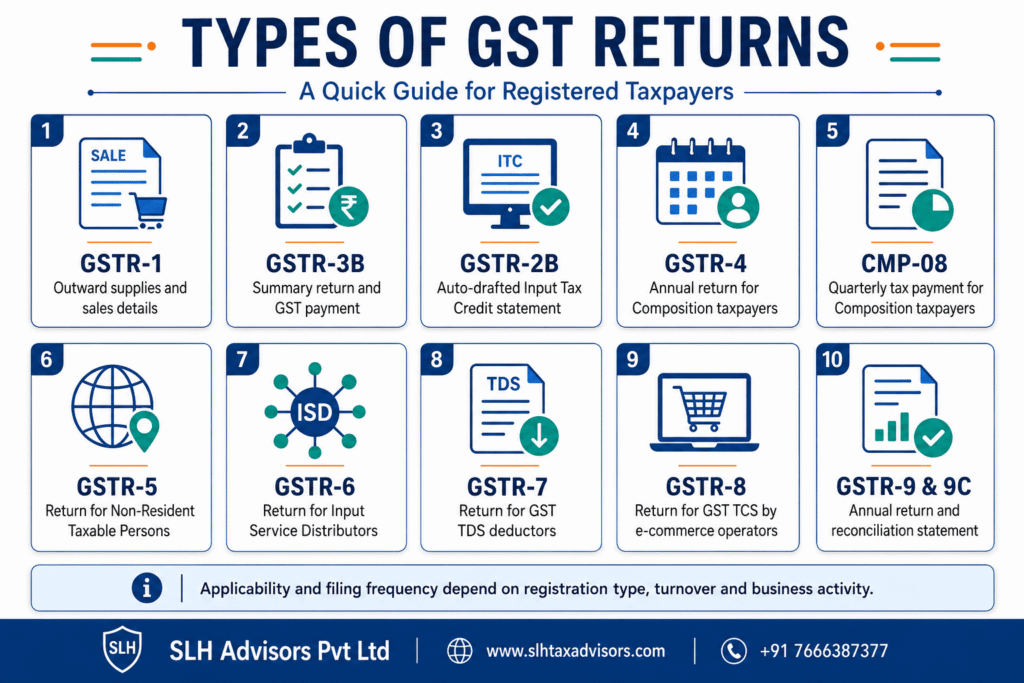
Major Types of GST Returns
1. GSTR-1: Details of Outward Supplies
GSTR-1 contains details of sales and outward supplies made during the tax period.
It generally includes:
- B2B invoices
- B2C transactions
- Export invoices
- SEZ supplies
- Credit and debit notes
- Advances received and adjusted, wherever applicable
- Nil-rated, exempt and non-GST supplies
- HSN or SAC-wise summary
- Amendments to earlier invoices
The regular due dates are:
- Monthly filers: 11th of the following month
- Quarterly filers under QRMP: 13th of the month following the quarter
These dates can be extended through government notifications. The official GST portal confirms the standard GSTR-1 filing dates.
2. GSTR-3B: Summary Return and Tax Payment
GSTR-3B is the summary return through which taxpayers declare their GST liability, claim eligible Input Tax Credit and pay the net tax due.
It covers:
- Taxable outward supplies
- Zero-rated and exempt supplies
- Reverse-charge transactions
- Eligible and ineligible Input Tax Credit
- ITC reversal and reclaim
- Interest and late fees
- Tax payable and tax paid
For monthly filers, the standard due date is generally the 20th of the following month. Quarterly filers under QRMP generally file GSTR-3B by the 22nd or 24th of the month following the quarter, depending on the state or Union Territory.
The GST portal confirms that the standard due date for monthly GSTR-3B filing is the 20th of the following month.
3. GSTR-2B: Input Tax Credit Statement
GSTR-2B is not a return to be filed. It is an auto-drafted Input Tax Credit statement generated for the recipient based mainly on information submitted by suppliers.
Before claiming ITC, businesses should reconcile:
- Purchase register
- Supplier invoices
- Debit and credit notes
- Import documents
- GSTR-2B
- Goods or services actually received
- Payment status of suppliers, where relevant
The appearance of an invoice in GSTR-2B does not automatically make the ITC eligible. All conditions prescribed under the GST law must also be satisfied.
4. GSTR-4: Annual Return for Composition Taxpayers
GSTR-4 is an annual return applicable to taxpayers who have opted for the Composition Scheme.
Composition taxpayers generally make quarterly tax payments through Form CMP-08 and file GSTR-4 annually. They cannot normally collect GST separately from customers or claim Input Tax Credit.
5. CMP-08: Quarterly Payment by Composition Taxpayers
CMP-08 is used by composition taxpayers to declare and pay their self-assessed tax liability for each quarter.
The usual due date is the 18th of the month following the quarter, subject to any extension notified by the government.
6. GSTR-5: Return for Non-Resident Taxable Persons
GSTR-5 applies to non-resident taxable persons registered under GST for undertaking taxable transactions in India.
It includes details of imports, outward supplies, Input Tax Credit and tax payments.
7. GSTR-6: Return for Input Service Distributors
An Input Service Distributor files GSTR-6 to report the receipt and distribution of Input Tax Credit among eligible units or branches.
Accurate ISD compliance is particularly important for businesses having a head office and multiple GST registrations.
8. GSTR-7: GST TDS Return
GSTR-7 is filed by persons required to deduct TDS under GST. It contains details of tax deducted, payments made and TDS liability.
9. GSTR-8: GST TCS Return
GSTR-8 is filed by e-commerce operators required to collect Tax Collected at Source under GST.
10. GSTR-9: Annual Return
GSTR-9 provides a consolidated summary of:
- Outward supplies
- Inward supplies
- Input Tax Credit
- Tax paid
- Refunds and demands
- HSN-wise details
- Adjustments relating to the financial year
The regular due date is 31 December following the end of the relevant financial year, unless extended.
The government may exempt specified classes of taxpayers from filing GSTR-9 for a particular financial year. Therefore, applicability should be verified separately every year.
11. GSTR-9C: Reconciliation Statement
GSTR-9C is a self-certified reconciliation statement generally applicable where aggregate turnover exceeds the prescribed limit, currently ₹5 crore for the relevant financial year, subject to notified provisions.
It reconciles the figures reported in the annual return with the annual financial statements. Where GSTR-9C is applicable, filing only GSTR-9 may not be treated as completion of the annual-return obligation.
12. GSTR-10: Final Return
GSTR-10 is applicable when a GST registration is cancelled or surrendered.
It is generally required to be filed within three months from the effective date of cancellation or the date of the cancellation order, whichever is later.
QRMP Scheme for Small Taxpayersayers
The Quarterly Return Monthly Payment scheme is available to eligible taxpayers having aggregate annual turnover of up to ₹5 crore.
Under QRMP:
- GSTR-1 is filed quarterly.
- GSTR-3B is filed quarterly.
- Tax is paid monthly for the first two months through Form GST PMT-06.
- Eligible B2B invoices may be reported through the Invoice Furnishing Facility.
The QRMP scheme reduces return-filing frequency, but it does not eliminate monthly tax-payment and reconciliation responsibilities.
Important GST Compliance Updates
Invoice Management System
The Invoice Management System allows recipient taxpayers to take action on invoices and other documents reported by suppliers.
The recipient may generally:
- Accept a document
- Reject a document
- Keep it pending, wherever permitted
IMS has been available from the October 2024 tax period. Businesses should regularly review IMS before finalising Input Tax Credit and filing GSTR-3B
E-Invoicing Requirements
E-invoicing is presently applicable to notified taxpayers having aggregate annual turnover of ₹5 crore or more, subject to prescribed exemptions and turnover conditions.
For taxpayers having aggregate annual turnover of ₹10 crore or more, e-invoices dated on or after 1 April 2025 generally need to be reported to the Invoice Registration Portal within 30 days from the invoice date.
Businesses should verify:
- Whether e-invoicing applies based on turnover in any relevant preceding financial year
- Whether the document requires an IRN
- Whether the IRN and QR code appear on the invoice
- Whether cancelled invoices have been correctly handled
- Whether e-invoice data matches GSTR-1 and the books
Monthly GST Compliance Checklist
Before filing GST returns, every business should complete the following checks:
- Reconcile sales invoices with the accounting software.
- Verify e-invoices and Invoice Registration Numbers.
- Check cancelled invoices and revised documents.
- Verify debit notes and credit notes.
- Reconcile turnover between books and GSTR-1.
- Match the purchase register with GSTR-2B.
- Review invoices in IMS.
- Identify ineligible or blocked Input Tax Credit.
- Calculate proportionate ITC reversal, wherever applicable.
- Check Reverse Charge Mechanism liability.
- Verify advances and advance adjustments.
- Reconcile e-way bills with invoices and sales records.
- Confirm tax classification and GST rates.
- Review HSN and SAC codes.
- Reconcile output liability between GSTR-1 and GSTR-3B.
- Check the electronic cash, credit and liability ledgers.
- Calculate interest and late fees, if applicable.
- File the return using the authorised DSC or EVC.
- Download and retain the filed return and ARN.
- Confirm that the return status shows “Filed.”
Common GST Return Filing Mistakes
Businesses should avoid the following errors:
- Filing GSTR-1 without reconciling sales with books
- Claiming ITC only because an invoice appears in GSTR-2B
- Claiming blocked or ineligible ITC
- Missing Reverse Charge Mechanism liability
- Reporting an incorrect GSTIN
- Selecting the wrong place of supply
- Using an incorrect GST rate or HSN/SAC code
- Ignoring credit notes and sales returns
- Mismatch between e-invoices and GSTR-1
- Paying tax under the wrong tax head
- Filing a nil return despite having transactions
- Not reviewing IMS records
- Delaying GST registration cancellation compliance
- Not filing returns because there was no business activity
- Failing to maintain proper supporting documents
Consequences of GST Non-Compliance
Delayed or incorrect GST compliance may lead to:
- Late fees
- Interest on delayed tax payment
- Restriction or reversal of Input Tax Credit
- Notices for differences between GSTR-1 and GSTR-3B
- Notices for mismatch between ITC claimed and GSTR-2B
- Blocking of e-way bill generation
- Suspension or cancellation of GST registration
- Recovery proceedings
- Penalties for incorrect invoices or returns
- Difficulty in obtaining loans or participating in tenders
- Loss of customer confidence, especially in B2B transactions
Filing a return does not by itself ensure compliance. The figures reported must be accurate, supported by documents and properly reconciled with the accounting records.
Documents Required for GST Return Filing
Businesses should keep the following records ready:
- Sales invoices
- Purchase invoices
- Debit and credit notes
- Export and import documents
- E-invoice data
- E-way bill records
- Bank statements
- Expense bills
- Reverse-charge transaction details
- GSTR-2B statement
- Electronic ledger balances
- Previous GST returns
- HSN/SAC-wise turnover details
- Details of exempt and non-GST supplies
- Stock transfer and branch transfer records
GST records should generally be preserved for the period prescribed under the applicable GST law.
Need Assistance with GST Compliance?
SLH Advisors Pvt Ltd provides professional assistance for:
- GST registration
- GSTR-1 and GSTR-3B filing
- GST reconciliation
- GSTR-9 and GSTR-9C
- E-invoice and e-way bill compliance
- GST cancellation
- GST notices and departmental replies
- Accounting and bookkeeping